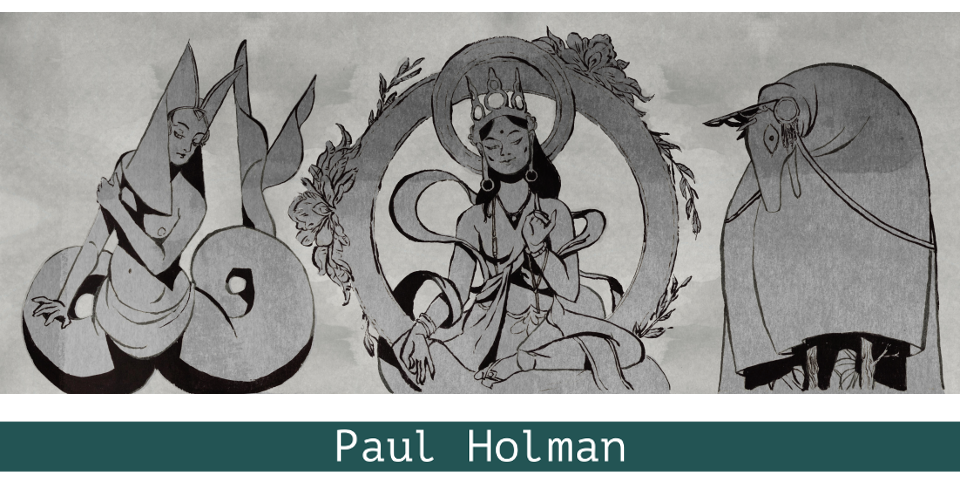
Sussex Coils and Loops documents a series of ritual art actions carried out at sites in south-east England which have serpent or dragon legends associated with them. The workings were performed between the winter solstice of 2017 and the summer solstice of 2022.
So, why Sussex? Because I’ve lived most of my life in the county, apart from fifteen years in London, so it’s very much my home turf. And why coils and loops? I think that probably had its origin in the 1990s, when I was friends with the great biker poet Bill Griffiths: I can remember being impressed by a description of him as someone who wrote formally innovative poetry, but with dragons. And I thought that this was funny, but actually quite a desirable thing to have on one’s CV. It also seemed a good entry point for a book which was intended to contain hermetic elements, but to be approachable by non-specialist readers.
The coils of the title belong to a diverse array of scaly monsters: these include the dragon which St Leonard battled in the forest which bears his name, a “most noysome and dreadfull” serpent which subsequently made its home there in the early seventeenth century, the Knucker of Lyminster and its kindred, and the great worm said to sleep in concealment within Bignor Hill. The loops are Sussex Loops: mysterious, serpentine Bronze Age artefacts with a strictly local distribution, centred upon Brighton. Together, these provide a starting point for excursions into interrelated sites and folklore, taking in mosaic portrayals of Medusa from the Roman occupation, an Anglo-Saxon female saint, various antiquarian clergymen, and a home-grown 8-bit video game along the way.
Sussex Coils and Loops is informed both by my long-standing interest in folklore, and by my ambiguous feelings about the very concept of folk tradition. I’m very much in favour of what Common Ground described as local distinctiveness, but am concerned to maintain an appreciation of that as multifarious and complementary, in contrast to a narrow exclusive nativism.
An issue which preoccupied me, but which did not come into clear focus until I had been engaged upon the book for some time, was the inherent tension between static and dynamic models of transmission. In contrast to an inherently conservative notion of authenticity, with the gatekeeping which that implies, I propose a concept of folk tradition as an unstable, metamorphic process which is constantly taking on provisional forms. While my book is based upon careful research and fieldwork, my guiding principles have been that folklore is by its nature open source and that the best way to preserve something is to use it.
I have tried to reflect the protean nature of the book’s subject matter by using a wide range of formal devices to present the texts themselves: at the outset, I envisaged a framework which could incorporate both concrete poetry and a mummer’s play.
The book opens with a mesostic, a form beloved by John Cage. The horizontal lines of text are derived from a 1614 pamphlet concerning “a strange and monstrous serpent or dragon” which infested the commercial rabbit warrens in St Leonard’s Forest, while the vertical spine spells out a passage from Revelation, a text cited in the seventeenth-century publication, which is itself something of a moral tract.
Reading: 1614 (SC&L, pp.2-3).
Sussex Coils and Loops is constructed around ritual practice: this is not always directly reported in the text, but it underpins it throughout. Because the book is intended to be an outward-facing work, examples of this material are presented in such a manner that they can be recognised as magical workings by an informed reader or, less resonantly, interpreted as art actions tailored to specific places.
I wanted real time to be a point of intersection in the book, in contrast to the shifting, eternally returning chronology of much folk material. I have in any case an interest in the specific and accidental, of making work which would be different if made on a different day. This is expressed in the provisional nature of some of the workings described here, of using what came to hand in a particular moment and location.
“The Hidden Thing, the Herdsman, the Goad” is essentially a walking text, but it is the most complex in the book in terms of its register – depending upon the reader, it can be interpreted as a simple performative grimoire, as a set of instructions for an environmental art action, as an attempt to thread distinct items of local folklore together, using the landscape as a medium, or even as a horror story.
Reading: THE HIDDEN THING, THE HERDSMAN, THE GOAD (pp.26-30).
In this text, I present the landscape as being formed by human narrative and belief as much as it is by human cultivation and settlement. It is comprised of strata of story, which I have combined afresh, pulling together not only the tales of dragons and serpents associated with St Leonard’s Forest, but also the folkloric figures of Squire Paulett and Mick Mills, both of whom are based upon eighteenth-century inhabitants of the area, the so-called Persian Princess Helena Bennett, whose romantically unfortunate biography inspired Shelley to compose a rather lacklustre drama, and the modern poltergeist phenomena related to the Doomsday Church.
While the folklore referenced here exists as little more than isolated images – lilies of the valley springing up where the forest floor had been spattered with the blood shed by St Leonard during his combat with the dragon, Mick Mills in a fiery foot race with the devil, the spectral Captain Powlett hitching rides with travellers through the forest – the book also incorporates material which has long since attained an extended written form: classical analogues, Anglo-Saxon texts, the popular literature of medieval Christianity.
If some saints’ lives have been set down at fabulous length, others remain as a mere trace. Lewinna was a miracle-working Sussex saint: martyred in the seventh century, she had a flourishing local cult by the eleventh, but all that is known of her now is the rather melancholy story of the abduction of her relics by a visiting Flemish monk. She has been reimagined as a dragon-slayer in contemporary fantasy novels set in the Wyrde Woods of West Sussex, a fate which I trust would not have displeased her too greatly. In writing about Lewinna, I have also had a few things to say about Anna Campbell, who died in support of the Rojava Revolution a little over eight years ago. I had a very peripheral acquaintance with her, and was both curious and perturbed at some of the ways in which her name and image have been presented after her death.
Reading: LEWINNA (p.107).
I mentioned earlier that the workings detailed in this book were performed from 2017 to 2022. That meant, of course, that it was impacted by the COVID-19 pandemic, and by the lockdowns of 2020 and 2021. I had already embedded elements of scrying and remote working into my praxis, and these stood me in good stead under confined conditions. But I had been going flat-out, visiting sites and libraries and archives as soon as it became evident that restrictions would be imposed.
Much of my attention was given to the Knucker of Lyminster during this period, which was no bad thing, as there was less to do on-site than I had hoped, the Knucker Hole itself being privately owned and inaccessible.
The tale of the Knucker was first set down, in very general terms, in 1866, and was only recorded in its most characteristic form as recently as 1929, by Charles G. Joiner in the pages of the Sussex County Magazine. This account describes how the dragon emerges from its pool to invade a richly associative landscape, haunting the watercourses around the village and advancing along the river to Arundel. In the folktale’s single most memorable image, the Knucker positions itself on the causeway between Arundel and Lyminster, devouring passers-by “like a toad licking flies off a stone”. The Mayor of Arundel offers a reward to rid the area of this pest, which Jim Puttock, an enterprising local lad, sets out to claim. He calls in turn upon the skills of the blacksmith, the miller and the woodmen, and bakes a colossal pudding. The Knucker swallows this down, along with the carriage and team of horses used to deliver it, only to be incapacitated by indigestion, providing Jim with the opportunity to cut off its head with an axe.
There is one known variant of this narrative, recorded by the novelist and screenwriter Rosemary Anne Sisson, who maintained a lifelong connection with Lyminster. Here, the hero is named Jim Pulk, most probably a mishearing of Puttock: he cooks a huge pie for the Knucker, and laces it with poison. He conveys the pie to the pool, then waits behind a hedge for the monster to rise and accept the bait. Once the poison has worked its effect, Jim emerges from hiding and decapitates the Knucker with a scythe. He goes to the local inn, the Six Bells, for a celebratory drink: he takes a swig of beer, wipes his hand across his mouth, and promptly falls dead, presumably a victim of his own poison rather than any venom of the dragon.
In both of these iterations, Jim is eventually buried beneath the Slayer’s Stone, a medieval coffin slab carved with a cross set over a herring-bone pattern, which now stands inside the village’s church of St Mary Magdalene. The name of the inn refers to the six bells of the church: there is a tradition of their ropes being joined together and lowered into the Knucker Hole in an unsuccessful attempt to measure the depth of the pool.
This story has been expanded and remixed in various ways, and transposed to other settings. The version which I found most engaging was a vintage video game, coded by a programmer who had known the folktale since childhood:
Reading: I SAWE NEVER FOWLER WORMES 13 (pp.81-83).
I’m going to finish off with a poem which was originally composed for Shape-Shifter, a tribute volume to my friend of decades, Gavin Selerie. Gavin was interested in Sussex Coils and Loops as he had lived near to some of the sites which figure in my book back in the 1970s, and had written about them himself in his first major poem, Azimuth. I followed his path, page by page, in my text: although I frequently employ bricolage in my own writing, I had never previously appropriated a friend’s words in this way, and was concerned to assemble a text which would both enable me to find speech through a process of cutting and enjambment and to preserve Gavin’s original voice, creating a dialogue between us.
Reading: AZIMUTH FRAGMENTS (pp.141-142).